A Comprehensive Guide to Calculating ROI for Rooftop Solar Systems in the US
Investing in a rooftop solar system is a smart move towards embracing green energy while potentially saving on electricity bills.
READ MORE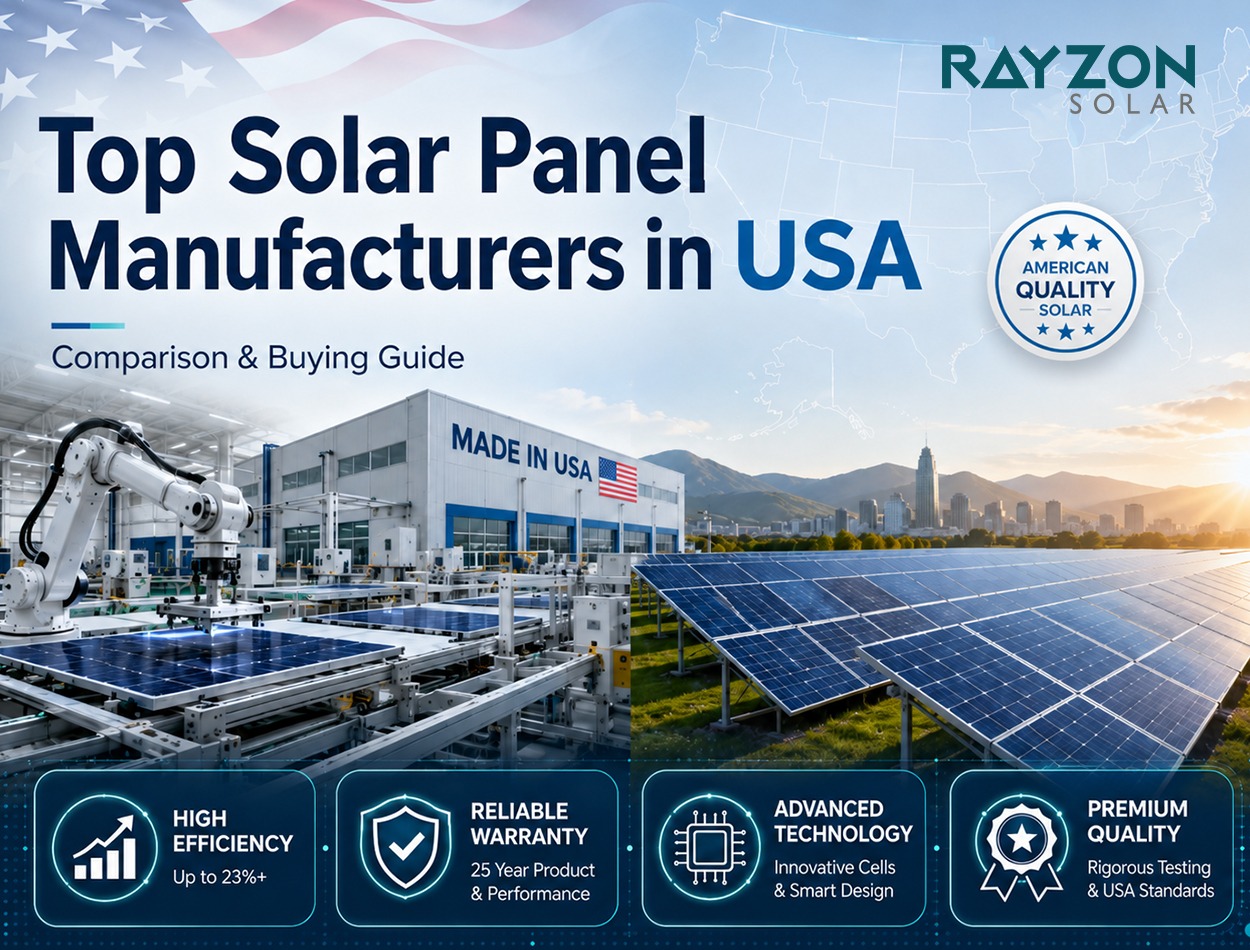
The domestic clean energy sector is experiencing unprecedented industrial expansion, positioning solar panel manufacturers in USA at the forefront of the global energy transition. Driven by aggressive tax structures under the Inflation Reduction Act (IRA), the demand for localized engineering and assembly has made aligning with top solar panel manufacturers in USA a primary objective for commercial developers, utility operators, and residential installers alike. The surging interest in made in USA solar panels is redefining domestic procurement strategies, with project developers seeking to satisfy strict local sourcing requirements while insulating themselves from global tariff volatility. The rapid development of localized manufacturing has positioned several key solar panel companies in USA as central players in the North American market. Identifying the most reliable partners requires a deep dive into the corporate histories, vertical integration strategies, and technological innovations of these leading brands.
The domestic manufacturing landscape is characterized by a mix of long-standing global leaders establishing local footprints, rapid expansions by domestic clean technology firms, and strategic joint ventures. When evaluating solar panel companies in USA, five leading brands stand out for their technical execution, manufacturing capacity, and long-term bankability. These companies specialize in high-efficiency architectures engineered to meet the strict demands of the U.S. commercial, residential, and utility sectors.
The following quick comparison table summarizes the core profiles of these leading manufacturers:
|
Manufacturer |
Headquarters / Primary U.S. Base |
Core Product Technology Type |
Efficiency Range |
Primary Application |
|
Rayzon Solar |
USA Operations |
N-Type TOPCon & Mono PERC 3 |
21.78% - 23.25% |
Residential, Commercial & Utility |
|
QCells |
Cartersville & Dalton, Georgia |
Q.ANTUM NEO N-Type TOPCon |
Up to 22.5% |
Residential, Commercial & Utility 4 |
|
Jinko Solar |
Jacksonville, Florida |
Tiger Neo N-Type |
Up to 22.9 |
Commercial & Utility |
|
JA Solar |
Phoenix, Arizona Presence |
DeepBlue Series |
Up to 22.8 |
Utility & Commercial |
|
SEG Solar |
Houston, Cypress & Tomball, Texas |
ALPINE N-Type HJT & TOPCon |
Up to 23.34% |
Commercial & Utility |
Selecting a hardware partner is one of the most critical decisions in any solar investment, whether for a residential roof or a multi-megawatt utility array.
The manufacturer's engineering standards directly dictate the system's Levelized Cost of Energy (LCOE), long-term power degradation, and total return on investment (ROI). Navigating the landscape to select the best solar panel manufacturers in USA requires a metric-driven approach that balances raw performance with corporate financial stability.
The choice of manufacturer affects the long-term viability of solar assets in several fundamental areas:
Weather-Resilient Performance: Premium panels are engineered with superior temperature coefficients to maintain high electricity yields during extreme summer heatwaves and low-light winter days.
Cutting-Edge Efficiency: High-efficiency architectures (such as N-type TOPCon and HJT) generate more power in limited spaces, directly lowering racking, wiring, and overall installation costs.
Warranties You Can Trust: Sourcing from top brands guarantees robust product and linear performance warranties, securing your energy output over a 25- to 30-year system lifecycle.
Long-Term Corporate Bankability: Partnering with Tier 1 manufacturers ensures your hardware provider has the financial strength to remain solvent and honor warranty claims decades down the road.
Rigorous Quality Control: Leading brands utilize highly automated smart factories to eliminate manual assembly errors, preventing common failures like micro-cracks, bad laminations, or early delamination.
Safety & Durability Certifications: Premium modules carry recognized certifications (like UL 61730 and IEC 61215), proving they can withstand heavy snow loads, high wind forces, and corrosive coastal salt mist.
Accelerated Financial Savings: High-quality panels maximize direct self-consumption and shorten your payback timeline, which is especially critical under restrictive modern utility billing rules like California’s NEM 3.0.
Rayzon Solar has established a unique position as a fast-growing global brand with a rapidly expanding footprint in the United States. It claims the distinction of being the first Indian solar firm to actively establish manufacturing capabilities in the US, planning a dedicated 500 MW solar module factory. This strategic move is designed to supply high-efficiency, U.S.-compliant modules directly to North American EPCs, developers, and distributors.
Rayzon Solar displays an extensive array of engineering achievements and certifications. Backed by an escalating global manufacturing capacity of 11.3 GW (progressing toward a 12 GW target by late 2025/2026), Rayzon Solar is aggressively scaling its supply chain.
This expansion is supported by backward integration plans, including a 3.5 GW solar cell facility scheduled for Q3 2026 and a 1500 MTPA aluminum processing unit by Q3 2025.
The comprehensive advanced products catalog outlines high-wattage bifacial, TOPCon, and Mono PERC modules engineered to minimize LCOE and maximize ROI. The corporate mission detailed on the corporate background and journey page shows a focus on quality, reliability, and advanced technology.
When analyzing the best solar panel manufacturers in USA, Rayzon Solar stands out for its high-performance, double-glass architectures:
Why Choose Rayzon Solar
Rayzon Solar has emerged as a preferred partner for developers seeking high-efficiency modules that balance raw performance with structural reliability, proving its versatility among commercial solar panel manufacturers and utility-scale solar panel manufacturers alike. The company backs its residential and commercial modules with a 15-year materials and workmanship warranty and a 30-year linear performance warranty, guaranteeing that degradation will not exceed 1% in the first year and 0.4% annually from year 2 to year 30. All modules carry UL, IEC, and CE certifications, ensuring compliance with Arizona's dry heat, California's coastal salt mist, and northern snow loads. As one of the expanding solar module manufacturers USA looks to for regional diversification, Rayzon’s localized distribution and warehousing strategies assure short lead times.
Identifying the best solar panel manufacturers in USA requires evaluating the scale of localized capital investments. QCells, a subsidiary of the South Korean conglomerate Hanwha Group, has executed a massive billion manufacturing expansion in Georgia, creating the country’s largest and only fully vertically integrated solar factory. This investment represents a direct bet against international supply chain disruptions, allowing developers to bypass tariff swings and secure reliable, domestic components.
Sourcing from verified Tier 1 solar manufacturers offers the necessary financial security for utility-scale investments. Jinko Solar is a global giant that surpassed 400 GW in cumulative worldwide deliveries in early 2026, representing the largest historical volume in the industry. In the United States, Jinko has maintained a stable manufacturing presence in Jacksonville, Florida, which operates a 2 GW solar module assembly plant, making them one of the key solar module manufacturers USA hosts.
JA Solar, headquartered in Beijing, has long been a major supplier of high-efficiency cells and modules globally, operating dozens of manufacturing bases. The company established a 2 GW annual capacity manufacturing facility in Phoenix, Arizona, representing a to investment to assemble its high-performance Deep Blue series.
Founded in 2021 and headquartered in Houston, Texas, SEG Solar has quickly emerged as one of the fastest-growing domestic solar brands. SEG has executed a rapid, multi-phase manufacturing expansion plan in Texas, securing their position among the major PV module manufacturers USA relies on.
Cypress, Texas Plant (Q3 2026): An investment adding 4 GW of annual module production capacity, equipped to run high-efficiency HJT and TOPCon lines.
When evaluating USA solar panel brands, looking beyond simple nameplate wattages to analyze temperature coefficients, degradation rates, and mechanical load tolerances is essential. This thorough technical comparison helps developers evaluate the best solar panel manufacturers in USA based on empirical performance data:
|
Feature |
Rayzon Solar |
QCells |
Jinko |
JA Solar |
SEG Solar |
|
Module Type |
Double-glass Bifacial N-Type, All-Black Monofacial |
All-Black Monofacial, Double-Glass Bifacial N-Type |
Mono-facial N-Type, Dual Glass Bifacial |
Monocrystalline Bifacial Dual Glass |
N-Type Monocrystalline, Half-Cell Bifacial Dual Glass |
|
Efficiency |
21.78% - 23.25% |
Up to 22.5% |
Up to 22.9% (Tiger Neo) / 24.27% (Tiger Neo 3.0) |
Up to 22.8% (DeepBlue series) / 23.3% (DeepBlue 4.0 Pro) |
Up to 23.34% |
|
Warranty |
15-year product, 30-year linear performance warranty with 0.4% annual degradation |
25-year residential product & performance warranty / 12-year commercial product & 30-year performance warranty |
25-year product, 30-year performance warranty (Tiger Neo / Neo 3.0) |
25-year product, 30-year linear performance warranty with 0.4% annual degradation (DeepBlue 4.0 Pro) |
15 to 30 years product, 30-year linear performance warranty with 0.42% annual degradation |
|
Technology |
N-Type TOPCon & Mono PERC, Multi Busbar, Half-Cut Cells |
Q.ANTUM NEO N-Type TOPCon, Anti-PID, Anti-LeTID |
N-Type TOPCon, SMBB, Hot 2.0, non-destructive cutting |
N-Type Bycium+ cell architecture, multi-busbar, glass-glass |
ALPINE N-Type HJT & TOPCon, Super Multi Busbar |
|
Residential |
Black N-Type TOPCon Residential Series (425 Wp - 440 Wp, 108 half-cut cells) |
Q.TRON BLK M-G2+ (Up to 440 Wp), Q.TRON BLK AC Series |
Tiger Neo 440W, Tiger Neo 3.0 (460W-485W All-Black) |
JAM54D41 (465W Full Black) |
ALPINE N Series 96-cell (435W-450W), 108-cell (495W-515W) |
|
Commercial |
L'LIOS TOPCon Series (580 Wp & 620 Wp, 132 & 144 half-cut cells) |
Q.TRON XL-G2.3/BFG (625W Bifacial) |
Tiger Neo / Pro Series (585W - 660W) |
DeepBlue 4.0 Pro series (605W - 630W) |
ALPINE N Series 132-cell (up to 630W) |
|
Utility Scale |
TOPCon Glass-to-Glass Bifacial Series (580 Wp - 600 Wp, 144 half-cut cells) |
Q.TRON XL-G2.3/BFG (625W Bifacial) |
Tiger Neo 3.0 Bifacial (up to 670W) |
DeepBlue 4.0 Pro series (605W - 630W) |
ALPINE N Series 132-cell (up to 725W) |
|
Certifications |
UL 61215, UL 61730, IEC 61215, IEC 61730, CE, ISO 9001/14001/45001 |
UL 61730, IEC 61215, IEC 61730, Quality Controlled PV (TUV Rheinland) |
IEC 61215, IEC 61730, CE, MCS, ISO 9001/14001/45001 |
IEC 61215, IEC 61730, UL 61215, UL 61730, TÜV SÜD, Salt Mist & Ammonia |
UL 61215/61730, IEC 61215/61730, IEC 62804 (PID), IEC 61701 (Salt Mist), IEC 62716 (Ammonia), ISO 9001/14001/45001 |
The massive investment in domestic solar manufacturing has accelerated a technology transition, with manufacturers abandoning legacy designs to produce high efficiency solar panels USA projects require. Leading USA solar panel brands rely on advanced engineering to optimize real-world yields:
Evaluating the best solar panel manufacturers in USA requires a systematic process that prioritizes performance metrics and corporate track records. Selecting the right partner from the list of solar panel manufacturers in USA requires assessing the following key parameters:
Efficiency — higher-efficiency modules produce more power per square foot, which matters most when roof space is limited.
Warranty terms — compare both the product warranty (defects) and the performance warranty (guaranteed output over 25 years) separately.
Certifications — UL listing and IEC certification aren't optional; confirming both is also how you separate genuine Tier 1 solar manufacturers from smaller assemblers reselling imported cells.
Manufacturing standards — a company with an actual US factory line is easier to hold accountable than one reselling rebranded imports.
Temperature coefficient — lower is better in hot climates, where output drops as panel temperature rises.
Installation network — even the best panel underperforms if installed by a crew unfamiliar with the manufacturer's mounting specs.
Customer support and claims process — ask how a warranty claim actually gets filed, and how long it typically takes.
Total cost of ownership — the cheapest panel per watt isn't always the cheapest system over 25 years once degradation is factored in.
Procuring modules from top-tier solar panel companies in USA guarantees robust after-sales support and minimizes asset risk. Sourcing from premier solar module manufacturers USA relies on, and working with the top solar manufacturers USA employs ensures major advantages:
The physical and electrical characteristics of solar panels are tailored to their target application.11 Selecting the correct physical footprint and electrical design is critical for
|
Metric / Parameter |
Residential Solar Panels |
Commercial & Utility Solar Panels |
|
Typical Cell Count |
108 Half-Cut Cells (or 96-Cell) |
132 / 144 Half-Cut Cells |
|
Weight Range |
45 lbs to 52 lbs |
72 lbs to 85 lbs |
|
Typical Dimensions |
67.8 x44.6 inches |
93.8 x 44.6 inches |
|
Aesthetics Focus |
All-Black (Black frame & backsheet) |
Clear/Silver Frame, Glass-Glass Bifacial |
|
Power Output Range |
400W to 440W |
580W to 720W+ |
|
System Voltages |
Up to 1000V DC |
Up to 1500V DC |
The Inflation Reduction Act's domestic-content tax credit adders have made made in USA solar panels meaningfully more attractive for developers chasing the extra incentive, and that policy shift is a big reason American solar panel manufacturers have opened or expanded so many facilities over the past few years. Beyond the tax credit, buyers increasingly value supply-chain security after years of tariff uncertainty and shipping delays tied to overseas sourcing. Domestic manufacturing also shortens lead times, supports US jobs, and cuts the carbon footprint tied to ocean freight — all factors pulling more of the market toward companies building capacity inside the country rather than importing it. For many developers, made in USA solar panels have gone from a premium niche option to the default choice on new contracts
High-quality USA solar panel brands carry various international certifications to verify mechanical integrity and fire safety:
Understanding the fine print of a solar panel warranty is critical to mitigating long-term operational risks. Manufacturers divide their coverage into distinct, legally binding agreements:
Ignoring the strict credentials of PV module manufacturers USA can lead to early-stage array failure and financial loss:
Choosing based on price per watt alone, ignoring degradation over 25 years
Skipping certification checks and assuming all panels are equally rated
Overlooking the performance warranty in favor of the product warranty's headline number
Buying from a manufacturer with no established US service or installer network
Not confirming efficiency and temperature-coefficient numbers against your specific climate
Expect continued growth in domestic capacity as IRA incentives mature, more automation on US production lines, and a steady shift from PERC to N-Type TOPCon as the new mainstream standard. Heterojunction (HJT) technology is moving from pilot lines toward wider US production, promising still-higher efficiency and better heat tolerance. Manufacturers are also starting to fold AI-assisted quality control into production lines to catch microcracks and cell defects earlier — a quieter but meaningful shift that should make domestically produced panels more consistent, not just more available, over the next few years
Simultaneously, companies are building smart factories leveraging advanced AI-driven manufacturing, automated robotics, and automated optical inspections to minimize defect rates and maximize throughput. To capture the full financial benefits of the IRA and mitigate tariff risks, firms are aggressively localizing upstream precursor components - constructing domestic ingot, wafer, and cell production lines on U.S. soil. This localization minimizes shipping emissions and ensures that clean energy components are manufactured with zero-carbon energy.<
The top solar panel manufacturers in USA in 2026 are Rayzon Solar, QCells, Jinko Solar, JA Solar, and SEG Solar. These leading top solar manufacturers USA hosts have established highly automated production facilities to supply advanced modules for residential, commercial, and utility-scale projects.
The active directory of solar panel companies in USA shows that prominent made in USA solar panels include QCells ( Dalton and Cartersville, Georgia) , Jinko Solar (Jacksonville, Florida) , and SEG Solar (Houston, Cypress, and Tomball, Texas).
Yes. made in USA solar panels carry superior quality control, longer warranties, and higher-grade materials designed for extreme local weather. Additionally, they satisfy the domestic content requirements of the Inflation Reduction Act, qualifying projects for a ten percent tax credit bonus.
QCells offers an exceptional residential warranty, backing its residential Q.TRON series with a 25-year comprehensive product and performance warranty (90.58% output guaranteed at year 25). Rayzon Solar and SEG Solar also deliver premium 30-year linear performance warranties with degradation rates capped at just 0.4% to 0.42% annually.
For residential rooftops, the QCells Q.TRON BLK and the Rayzon Black N-Type TOPCon (425W-440W) are ideal. They combine high efficiency (22.5%) with sleeker, all-black aesthetics and are highly rated for high snow and wind loads.
When evaluating commercial solar panel manufacturers, SEG Solar and Jinko Solar are among the premier choices. SEG’s 715W ALPINE N series offers industry-leading efficiency (23.02%), helping commercial developers significantly reduce Balance of System (BOS) wiring and racking costs.
Tunnel Oxide Passivated Contact (TOPCon) is an N-type cell architecture that incorporates an ultra-thin silicon oxide tunnel layer to passivate cell junctions, reducing recombination losses and boosting efficiency past the physical limits of traditional PERC modules.
Yes, particularly for ground-mounted, flat-roof, or highly reflective (high-albedo) surfaces. Bifacial modules generate up to 10% to 25% additional power from their backside, lowering the levelized cost of energy (LCOE) and boosting project ROI.
Solar panels should carry UL 61215/61730 (for fire and shock safety), IEC 61215/61730 (for general design standards), IEC 62804 (for PID resistance), and ISO 9001/14001 (for standardized quality and environmental management).
Tier 1 solar modules are engineered to operate reliably for 25 to 30 years or more. After 30 years, they will still produce around 80% to 88% of their original power rating based on their linear degradation curves.
The search for high efficiency solar panels USA markets demand leads directly to SEG Solar, which delivers up to 23.34% module efficiency on its ALPINE series. Rayzon Solar is also a major player, offering up to 23.25% module efficiency on its TOPCon lines.
Yes, N-type panels are superior. They utilize phosphorus-doped silicon which is immune to Light-Induced Degradation (LID). They also deliver lower temperature coefficients and higher cell efficiencies, outperforming standard PERC modules in real-world hot climates.
When assessing leading USA solar panel brands, developers must compare their BNEF Tier 1 status (bankability), module efficiency, temperature coefficient, annual degradation rate, warranty coverage duration, and domestic IRA tax compliance.
Solar panel performance is heavily dictated by solar irradiance (sunlight levels), shading, soiling (dust and snow buildup), ambient temperatures (hotter temperatures reduce cell voltage), and the module's internal temperature coefficient.
Yes, purchasing high efficiency solar panels USA contains ensures that the system will yield superior lifetime generation and carry lower degradation rates over time, outperforming cheaper, lower-tier modules.
Most utility-scale solar panel manufacturers design large-format double-glass modules with 144 half-cut cells, such as the Rayzon Solar 600W TOPCon series or QCells Q.TRON XL-G2.3/BFG 625W series , which minimize Balance of System (BOS) wiring and mounting labor.
A typical residential solar system ranges between $20,000 and $31,000 before incentives, averaging about $2.00 to $3.00 per watt. Premium modules and pairing with battery storage increase upfront costs but offer faster payback and better savings.
Yes, high-quality modules are engineered with anodized aluminum frames and double-glass covers certified to withstand down-force snow loads of up to 5400 Pa (or 8100 Pa) and up to 2400 Pa (or 3600 Pa) of wind suction force.
Buyers can verify certifications by reviewing the manufacturer's active product datasheets, looking up active listings on the UL Product iQ database, checking standard IEC certificates, or reviewing the California Energy Commission (CEC) list of approved photovoltaic modules.
SEG Solar is currently one of the fastest-growing brands, with massive multi-gigawatt manufacturing facilities in Cypress and Tomball, Texas scaling toward a planned 10.6 GW of annual domestic capacity.
The selection of a premier domestic hardware partner is a critical step in establishing a bankable clean energy project in the United States. Navigating the evolving U.S. landscape in 2026 requires balancing strict regulatory mandates with raw technical performance.
When comparing leading USA solar panel brands, the choice of a specific manufacturer should align with the core technical requirements of the physical installation site and the project's overall tax monetization strategy. Rayzon Solar has emerged as an exceptionally viable option among the PV module manufacturers USA offers, combining robust global manufacturing capabilities with highly durable, double-glass TOPCon module architectures.
Developers and EPCs must systematically evaluate their specific site conditions, local utility billing tariffs, and federal tax equity goals before procuring modules. To explore high-efficiency, U.S.-ready PV modules or to secure expert guidance on project design, contact the team at Rayzon Solar today.
Investing in a rooftop solar system is a smart move towards embracing green energy while potentially saving on electricity bills.
READ MORE
The search for clean and renewable energy sources in the US has seen the rise of solar energy in recent years.
READ MORE
Top solar panel manufacturer in the USA, as a Rayzon Solar stands at the forefront of the solar energy revolution in the United States, contributing significantly to the widespread adoption of solar power across the nation.
READ MORE